Bedding • Materials & Construction
Down Bedding Decoded: Fill Power, Construction, and Warmth
A comforter’s label can read like a compact technical manual: fill power, ounces, baffle boxes, shell fabric, seasonal weight. Each term describes a different part of the same system. Learn how those details work together, and the numbers become less mysterious—and much more useful.
Published October 13, 2026
On a cold night, warmth feels simple: pull the covers higher and settle in. But inside a down comforter, warmth is the result of a quiet architecture. Fine clusters of down hold pockets of air. A fabric shell contains them. Stitching or internal walls keep the fill in place. The quality of the insulation matters, but so does how much of it there is and how the garment-like structure is assembled.
That is why two down comforters with the same fill-power rating can feel quite different. One may be exceptionally lofty yet relatively light; another may contain more fill and provide more substantial insulation. A carefully built duvet can distribute warmth evenly, while a simpler design may create thin channels where the fill is compressed. Specifications are most useful when read together rather than treated as a contest in which the biggest number automatically wins.
This guide explains the central measurements and construction terms used for down bedding. It also shows how to think about warmth in relation to room temperature, personal comfort, and layering—because the best choice is not the warmest comforter in the abstract. It is the one that suits the conditions in which you sleep.
First, what is down?
Down is the soft underlayer found beneath the outer feathers of waterfowl. Rather than lying flat in a single direction, a down cluster branches into a three-dimensional form. Those fine filaments create spaces that trap still air, helping slow the movement of heat away from the body. In bedding, this structure gives down its distinctive combination of lightness, loft, and insulation.
Down is not the same as a feather. Feathers have a central shaft, which adds structure and can make a fill feel firmer or heavier. Bedding may contain pure down, a specified percentage of down blended with feathers, or another insulating material altogether. The fill description therefore matters: “goose down,” “duck down,” and a down-feather blend are not interchangeable labels, and the percentage or type of fill can influence both feel and performance.
Down does not generate heat. It helps retain heat already produced by the sleeper by limiting air exchange within the filling. That distinction explains why a comforter’s effectiveness depends on the complete design. A high-loft fill cannot compensate for an unsuitable warmth level, a shell that leaks fill, or construction that allows insulation to migrate away from parts of the bed.
Fill power: a measure of loft, not a warmth score
Fill power describes how much space a given weight of down occupies under a standardized test. In common bedding and outdoor-apparel usage, the number is expressed in cubic inches per ounce. A higher rating indicates that a smaller weight of down can expand to occupy more volume. Put simply, higher-fill-power down has greater loft for its weight.
Loft is important because the trapped air within a down cluster contributes to insulation. Higher fill power can make it possible to create a lofty, lightweight comforter without adding as much fill mass. But fill power does not tell you how many ounces of down are inside a finished comforter, how large the comforter is, or how much insulation the finished product provides overall. It is one part of the specification, not a complete warmth rating.
Consider two comforters with the same dimensions and the same fill power. If one contains more down by weight, it may feel fuller and provide more insulation. Conversely, a comforter with a higher fill-power rating might achieve a similar loft with less fill, potentially producing a lighter feel. The actual result depends on the product’s total design, including fill distribution, shell fabric, and construction.
Comparing fill power is most useful when the other details are also available. Look for the fill type, the amount of fill or a clear warmth category, the comforter’s dimensions, and construction information. If only one impressive number is presented, it does not provide enough context to predict how warm the bedding will feel.
A quick distinction
- Fill power describes the loft of a given weight of down.
- Fill weight describes how much filling is used in the comforter.
- Construction describes how the shell and internal compartments hold that fill.
- Warmth in use reflects the combined design and the sleeper’s environment and preferences.
Fill weight: how much insulation is actually inside
Fill weight is the total weight of the insulating material in a comforter, often stated in ounces or grams. It is a practical detail because it helps explain how much material is being used. Still, a fill-weight figure cannot be interpreted alone: a larger comforter naturally requires more fill than a smaller one to achieve a similar density, and different types of down may loft differently at the same weight.
When comparing options, confirm that the figures refer to the same size or account for the dimensions. A queen-size comforter and a king-size comforter are not directly comparable by fill weight unless their size is considered. Also check whether the stated number refers to the filling alone rather than the entire product, which includes the shell and other components.
Fill weight and fill power answer different questions. Fill power gives an indication of loft efficiency; fill weight tells you the amount of insulation used. A useful comparison brings those facts together. If a product provides neither fill weight nor a clear warmth category, the label may leave a significant part of the comforter’s performance unclear.
In many cases, manufacturers use seasonal labels—such as lightweight, all-season, or winter weight—instead of asking the reader to calculate warmth from technical specifications. These categories can help narrow the choice, but they are not universal standards. One company’s “all-season” model may not feel identical to another’s, so look for supporting details and consider the climate and sleeping conditions in your own home.
Baffle box and stitch-through construction
A comforter’s construction determines how its fill is held in place. Two common designs are stitch-through and baffle box. Each manages insulation differently, and neither is automatically best for every sleeper or situation.
Stitch-through construction
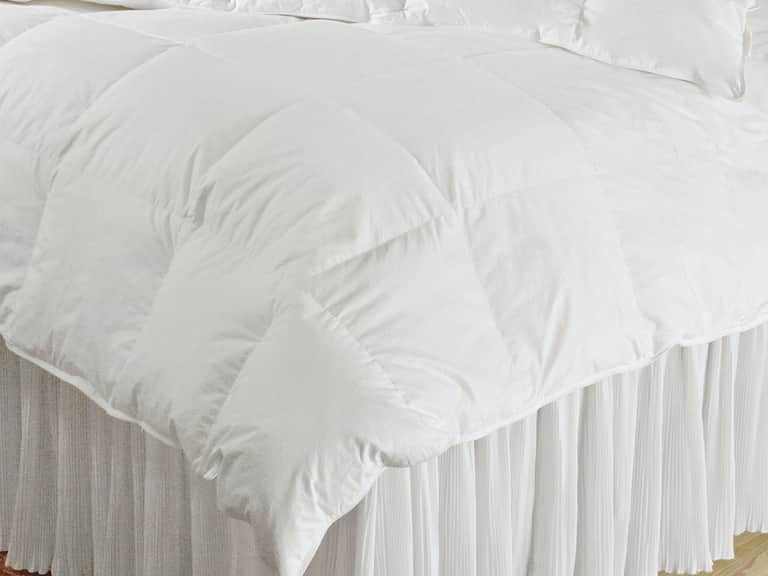
In a stitch-through design, the top and bottom layers of the shell are sewn directly together in a pattern of squares, rectangles, or channels. The stitching creates compartments that limit how far the fill can move. This method is relatively straightforward and can produce a flatter, more tailored profile.
Because the two shell layers meet at the seams, the fill is compressed along those lines. This can create narrow areas with less insulation than the centers of the compartments. The effect is not necessarily a flaw; it is a consequence of the design. In a lightweight comforter, a close-fitting duvet insert, or a product intended for milder conditions, stitch-through construction may be a practical approach.
Baffle-box construction
A baffle-box comforter uses fabric walls between the top and bottom shell panels to create three-dimensional chambers. Those internal walls allow the down to expand more fully rather than being pinched at every seam. When the design is well executed, the fill can form a deeper, more continuous layer, helping preserve loft and distribute insulation within each box.
Baffle-box construction is often used in comforters designed for greater loft or warmth. It does not guarantee a particular temperature performance, however. Box dimensions, baffle height, fill quantity, and the quality of assembly all affect the final result. Even baffles need appropriate filling and careful finishing to keep down from migrating or collecting unevenly.
Some comforters include loops at their corners or along their edges. These attach to ties inside a duvet cover and help keep the insert aligned. Such details do not change the inherent insulating capacity of the down, but they can improve day-to-day comfort by reducing bunching and shifting.
| Feature | Stitch-through | Baffle box |
|---|---|---|
| How it is made | Shell layers are sewn together directly. | Internal fabric walls separate the shell layers. |
| Typical profile | Flatter and more closely quilted. | Roomier chambers that allow greater loft. |
| Points to consider | Seams can compress fill along their lines. | Performance still depends on fill amount and chamber design. |
| Where it can make sense | Lightweight designs and a more tailored profile. | Designs intended to preserve loft and create a fuller layer. |
Shell fabric: the quiet partner in performance
The shell is the fabric envelope that contains the down. It needs to be soft enough for comfortable bedding, durable enough for regular use, and tightly woven enough to help prevent fine fill from escaping. Cotton is common, while other fibers and blends may be chosen for their texture, drape, or moisture-management characteristics.
Thread count can describe a fabric’s weave density, but it is not a stand-alone measure of comfort or quality. Fiber length, yarn construction, weave, finishing, and overall fabric weight all matter. A higher thread-count figure does not automatically mean a shell is more breathable or more durable. It is better read alongside the fiber content and the care instructions.
A duvet cover adds another protective layer. It helps shield the insert from everyday oils and soil, and it can be removed for routine laundering without washing the down-filled comforter as often. Corner ties or loops help keep the insert from sliding inside the cover. For anyone who prefers a cool, crisp layer against the skin, a cotton percale cover is one possible option; the DownTown Company Chris Percale Duvet Cover, for example, is made from long-staple cotton percale. The cover is separate from the insulating insert, so choosing it is primarily a decision about feel, care, and presentation.
Matching duvet warmth to the way you sleep
There is no single ideal warmth level. A comforter that feels reassuring in a cool bedroom may feel stifling in a heated apartment. A person who tends to sleep warm may prefer a lighter insert even during winter, while someone who feels cold easily may want a fuller layer. The best starting point is not the calendar; it is the temperature and comfort of the room where the bedding will be used.
Think about the full sleep system: room temperature, pajamas, sheets, blankets, mattress, and the number of people sharing the bed. A dense mattress protector or several existing layers can affect the overall sensation of warmth. Partners may have different preferences, so separate bedding or a duvet designed with different warmth zones may be worth considering where available.
- Warm bedroom or warm sleeper: Consider a lightweight insert, breathable shell, or a thin layer that can be adjusted easily.
- Variable seasons: A moderate all-season option may offer flexibility when paired with a removable blanket.
- Cold room or cool sleeper: A winter-weight comforter or a higher-loft design with adequate fill may provide a more enveloping layer.
- Uncertain conditions: Layering can be more adaptable than relying on one very heavy comforter. Add or remove a blanket as conditions change.
Seasonal labels are useful shorthand, not promises about a precise temperature. The words “summer,” “year-round,” and “winter” describe a maker’s intended use, but personal comfort varies. If a specification sheet provides dimensions, fill power, fill weight, construction, and a warmth category, you have a more complete basis for comparison than any one label can offer.
Down alternatives and different priorities
Not every sleeper wants or needs natural down. Some prefer an alternative because of sensitivities, personal values, care preferences, or budget. Synthetic fills can be engineered to imitate aspects of down’s softness and loft, although their properties and long-term behavior differ by material and construction.
For example, the DownTown Company Alpine Loft Down Alternative Comforter uses finely spun microfiber fill within a cotton cover and a 10-inch baffle-box construction. Its specifications describe an alternative to natural down, with a design intended to distribute fill and provide a lofty feel. As with any comforter, the appropriate choice depends on the sleeper’s needs, and its care guidance should be checked before purchase or use.
Comparing down and down-alternative bedding is not simply a question of which material is superior. Consider warmth, weight, breathability, laundering requirements, sourcing, and expected lifespan. A product that is easier to care for may be a better fit for a busy household; a different sleeper may place greater importance on lightweight loft or natural fill. The specification sheet is a map of trade-offs, not a verdict.
Care and storage affect long-term loft
Down can last when it is protected from unnecessary soil, moisture, and rough handling. A duvet cover helps reduce the need for frequent washing. Regularly airing the comforter and gently redistributing its fill can also help it maintain a fresh, even appearance. Follow the care label for the individual product: constructions and shell fabrics vary, so a method suitable for one insert may not suit another.
If the manufacturer permits machine washing, a large-capacity front-loading machine is generally preferable to a small washer with a central agitator, which can place stress on the fabric and seams. Use a mild detergent as directed and avoid bleach or fabric softener unless the care instructions specifically allow them. Drying deserves particular attention. Down should be completely dry before storage or use; residual moisture can encourage clumping and unpleasant odors. Low heat and patience are often more appropriate than rushing the process.
Before storing a seasonal comforter, make sure it is clean and thoroughly dry. Keep it in a breathable fabric bag or a well-ventilated storage space rather than sealing it in plastic for long periods. Compressing down for an extended time can reduce its ability to regain loft. When taking it out again, allow the fill time to expand and recover before judging how it performs.
Professional cleaning may be advisable for products with delicate shells or care labels that call for specialist treatment. Always consult the manufacturer’s instructions, warranty conditions, and cleaning recommendations. Good maintenance cannot change the original fill power, but it can help preserve the construction and loft that make the comforter comfortable.
Sourcing, certifications, and informed questions
Down is an animal-derived material, so sourcing is part of the decision for many consumers. Labels may refer to the country of origin, the type of bird, or a third-party standard. Certifications can offer a framework for assessing specific claims, but they do not replace reading the product details or understanding what a standard covers. When responsible sourcing matters to you, look for clear, verifiable information rather than relying on broad phrases such as “ethical” without supporting detail.
It can help to ask a short set of practical questions before choosing a comforter:
- What is the fill made of, and is the down blended with feathers or other fibers?
- Is fill power stated, and is fill weight or a clear warmth category also available?
- Does the construction use stitch-through seams or internal baffles?
- What is the shell fiber, and how should the product be cleaned?
- Are sourcing claims or certifications identified in a way that can be checked?
- Will the comforter fit the duvet cover, and does it have loops or ties to secure it?
These questions turn a list of technical terms into useful context. They also help distinguish measurable details from marketing language. A reliable description should make it possible to understand what is inside the comforter, how it is built, what care it needs, and what kind of use it is meant to serve.
A practical way to compare comforters
When several down bedding options are on the shortlist, start with the conditions rather than the headline number. Decide whether the bedroom is usually warm, cool, or variable. Note whether you sleep hot or cold and whether you prefer a light layer or a more substantial one. Then compare products in a consistent order: size, fill type, fill power, fill weight or warmth category, construction, shell, and care.
For instance, a lofty comforter with a high fill-power rating may be appealing, but if it is designed as a lightweight summer layer, it may not satisfy someone seeking winter warmth. A comforter with a more modest fill-power figure may still feel warmer if it contains more fill and has a design suited to colder conditions. The numbers work together; none should be allowed to stand in for the whole product.
Finally, consider flexibility. A moderate-weight insert can serve across more of the year when paired with a washable duvet cover and an extra blanket for colder nights. A very warm comforter may be ideal in a consistently cold room but less useful when temperatures fluctuate. The most sensible bedding choice is the one that balances comfort, maintenance, and adaptability in the place where it will actually be used.
The takeaway: read the system, not just the number
Fill power tells you how efficiently down lofts by weight. Fill weight tells you how much of it is present. Construction governs how that fill is distributed, while the shell contains it and influences the feel of the finished bedding. Warmth emerges from their combined effect, then meets the realities of bedroom temperature, personal preference, and layering.
Once these elements are separated, down comforter specifications become easier to interpret. Rather than assuming that the highest fill-power number guarantees the warmest bed, use it as one clue among several. Look for clear information, compare like with like, and choose a design that fits your sleeping environment. The result is not merely a better-informed purchase; it is a more comfortable night, shaped by the small structures of air, fabric, and carefully distributed fill.
Frequently asked questions
Does higher fill power always mean a warmer comforter?
No. Higher fill power indicates greater loft for a given weight of down, but warmth also depends on fill weight, comforter size, construction, and the intended warmth level.
What is the main difference between baffle-box and stitch-through designs?
Stitch-through construction sews the shell layers together, compressing fill at the seams. Baffle-box construction adds internal walls that create deeper chambers and allow the fill more room to loft.
Is fill weight enough to compare two comforters?
Not by itself. Compare fill weight alongside the comforter’s dimensions, fill type, fill power, construction, and warmth category.
Should a down comforter be washed often?
Usually, a duvet cover can help protect the insert and reduce how often it needs cleaning. Always follow the care label for the specific comforter, and make sure it is thoroughly dry after any permitted washing.

