Bedding materials and construction
What to Look For in a Down Duvet Manufacturer: Naturepedic’s Materials and Construction
A duvet’s comfort is not created by fill alone. The materials surrounding it, the way its chambers are sewn, and the clarity of its sourcing information all shape how it performs over time. Naturepedic’s Organic Down Duvet Insert offers a useful case study in reading those details closely.
Published November 15, 2026
At first glance, a down duvet can seem like a simple object: a soft layer of insulation inside a fabric shell. Yet the experience of sleeping under it depends on decisions made well before it reaches a bedroom. The type and quality of the down, the way it is processed, the shell’s weave, the arrangement of fill chambers, and the care instructions all influence warmth, breathability, durability, and maintenance.
That is why evaluating a down duvet manufacturer involves more than comparing a warmth label or a single fill-power number. Good specifications help explain what is inside the duvet and how it is assembled. They also make it easier to distinguish concrete material information from broad language about luxury, comfort, or sustainability.
Naturepedic’s Organic Down Duvet Insert provides a practical example. Its listed details include 750-fill-power USA soft white duck down, a certified organic cotton shell, and stitch-through box construction. Each describes a different part of the product. Taken together, they offer a starting point for understanding what a manufacturer’s specifications can—and cannot—tell you.
Begin with the fill, not the adjectives
Down is the fine, three-dimensional cluster found beneath the outer feathers of waterfowl. Unlike a feather, which has a central quill, a down cluster has delicate filaments that radiate from a central point. Those filaments trap air, helping the material insulate while remaining relatively light. The performance of a finished duvet depends on the fill’s quality and quantity, as well as the garment-like shell and construction that contain it.
Product descriptions often use terms such as “lofty,” “premium,” or “exceptionally warm.” Such words may convey an intended experience, but they do not provide the same information as a named fill type, a stated percentage, or a measurable rating. When comparing down duvets, look for the details that allow you to make a more grounded assessment:
- The type of down or feather used, such as duck down, goose down, or a blend.
- The fill-power rating, when supplied, and the units or testing context used to describe it.
- The total fill weight or a clear explanation of available warmth options.
- The stated origin of the fill and any documentation or certification related to sourcing.
- Information about cleaning, processing, and the finished product’s care requirements.
Naturepedic identifies its insert as containing 750-fill-power USA soft white duck down. This is more informative than an unspecified claim of “high-quality down”: it identifies the species category, color description, stated origin, and a performance measure. The specification still does not answer every question. For example, a shopper may want to know the percentage of down versus other material, the actual fill weight for the size being considered, and what evidence supports any sourcing or welfare claims.
What fill power measures—and what it does not
Fill power is a measure of the lofting capacity of down under a defined test. In broad terms, it indicates how much space a given weight of down can occupy when allowed to expand. A higher number is commonly associated with greater loft for the same weight of fill. That relationship can help manufacturers create a duvet that feels lofty without using as much material as a lower-fill-power design might require.
But fill power is not a warmth rating. It does not, by itself, say how warm a particular duvet will feel on a particular person in a particular room. A finished duvet’s warmth also depends on the amount of fill, its distribution, the duvet’s dimensions, its construction, the shell, and the sleeper’s environment and preferences. A high fill-power duvet with a relatively light fill weight may feel less warm than a lower-fill-power version designed for colder conditions.
For a more useful comparison, read fill power alongside the manufacturer’s warmth category and fill weight. If the description offers “lightweight,” “all-season,” or “winter” options, check whether those names are supported by distinct fill amounts or other construction details. Warmth labels are not universal measures across every company, so clear measurements help make comparisons less dependent on marketing language.
Naturepedic lists lightweight and all-season versions of its Organic Down Duvet Insert. Those options provide a useful reminder that one fill specification can be paired with different intended warmth levels. Before choosing, consider the room’s typical temperature, your preferred sleep climate, whether you use a top sheet or additional blanket, and how much insulation you want from a duvet.
The shell is more than a wrapper
The duvet shell must contain the fill while remaining comfortable against the body and durable through ordinary use. Its fiber, weave, finishing, and resistance to down leakage all matter. A tightly woven down-proof fabric is intended to keep fine fill from escaping through the shell, while the hand and breathability of the fabric influence how the duvet feels during sleep.
Naturepedic describes its insert as having a certified organic cotton cover. Cotton is a familiar bedding fiber, and its performance varies with yarn quality, weave, finishing, and fabric weight. The word “organic” speaks to how the fiber was produced under a particular standard; it does not by itself tell a reader how soft, breathable, tightly woven, or durable the finished shell is. A thorough product specification should identify the certification and, where available, describe the shell’s construction and any down-proof treatment.
Certification language is most useful when it is specific and traceable. Look for the name of the standard, the part of the product it covers, and the certifying organization. A certification may apply to the cotton shell rather than the down fill, or to a defined part of the supply chain rather than every component. These distinctions matter because material claims can be precise without applying equally to the entire finished duvet.
Naturepedic’s product details identify an organic cotton shell and list certifications including GOTS, MADE SAFE, and UL/GREENGUARD. When reading any such list, check what each certification evaluates and which materials or manufacturing stages are within its scope. A label should not be treated as a substitute for a clear bill of materials, nor should a certification for one component be assumed to certify every element of the product.
Stitch-through boxes and the question of cold spots
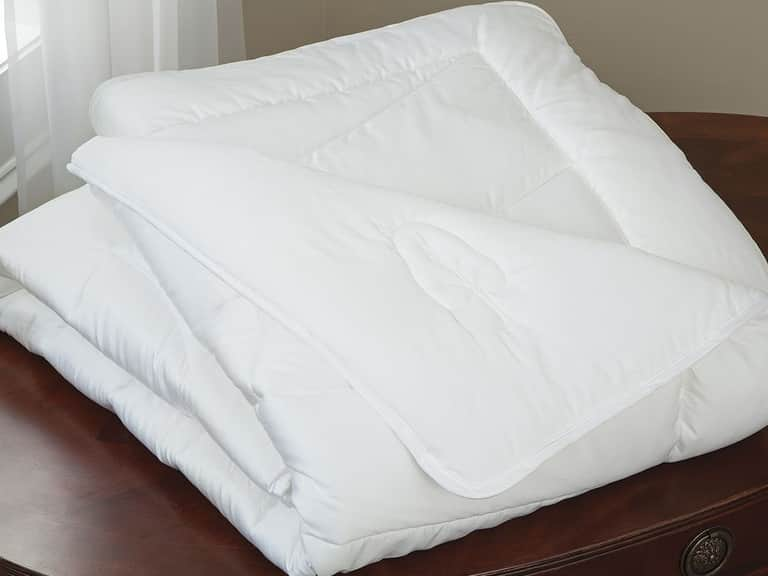
Down must be held in place to maintain an even layer across the bed. Duvet construction determines how that fill is divided and how much room it has to expand. Naturepedic describes its insert as using stitch-through box construction, a method in which seams join the top and bottom fabric layers in a grid-like pattern. These stitched boundaries create compartments that limit the movement of fill.
Stitch-through construction can help distribute the fill and keep it from collecting in one area, but the seams also connect the two sides of the shell directly. At those seam lines, the loft is reduced. In colder conditions, those lower-loft lines may feel cooler than the filled compartments, depending on the design and the sleeper’s environment.
Baffle-box construction works differently. Fabric walls are sewn between the upper and lower shell layers, creating three-dimensional compartments. Those walls allow down to expand more fully and can reduce direct compression at the seams. The design can support greater loft, though the actual result depends on baffle height, chamber dimensions, fill quantity, and workmanship. It is not automatically superior for every use: construction choices affect cost, profile, warmth, and the way a duvet lies on the bed.
When a manufacturer names the construction method, it gives the reader a useful point of comparison. Still, the label alone is not the whole story. Ask whether the compartments are sized to help distribute fill evenly, whether the duvet includes corner loops to attach to a cover, and how the maker intends the product to be used. A well-described construction should connect the technique to practical function without promising that one feature guarantees a perfect sleep climate.
Sourcing transparency: look for a chain of information
Down sourcing is a subject where general assurances can leave important questions unanswered. A manufacturer may describe down as responsibly sourced or ethically produced, but a reader needs to know what those phrases mean in practice. Useful information can include the stated country or region of origin, the sourcing standard or certification, the scope of that standard, and whether the claim applies to the fill in the specific product.
Origin is one part of transparency, not proof of every condition in the supply chain. A country-of-origin statement can help identify where material comes from, but it does not automatically document animal-welfare practices, processing conditions, or traceability. Similarly, a certification can provide a framework for verification, but its significance depends on the standard’s requirements and the product’s coverage under that standard.
Naturepedic’s published information identifies USA duck down and lists several certifications for the insert. Readers researching a down duvet manufacturer can use that information as a starting point, then look for the accompanying certification details. A clear, careful description should make it possible to determine which claims refer to the shell, which refer to the fill, and which refer to the finished item.
It is also reasonable to look for disclosure about processing. Down must be cleaned and prepared for use, and the resulting material needs to meet appropriate hygiene and quality requirements. A manufacturer that explains the process in accessible language helps readers understand the path from raw material to finished fill. Where that information is not readily available, a direct question to the company may clarify what is documented and what is not.
Construction and materials work as a system
It is tempting to evaluate a duvet by isolating one impressive number or one attractive material claim. In reality, the insert functions as a system. Down provides loft and insulation. The shell contains the fill and creates the surface that meets a duvet cover. The seams and compartments control distribution. The size and warmth option determine how the item covers the bed and fits the sleeper’s needs.
For example, high-loft down cannot perform as intended if it is compressed by insufficient chamber space or unevenly distributed in a way that leaves thin areas. A well-made shell can help contain the fill, but its fiber and weave also influence the duvet’s feel and maintenance. A stitch-through grid may offer a straightforward, stable structure, but the number and placement of seams affect the finished pattern of loft.
Naturepedic’s stated combination—750-fill-power duck down, an organic cotton shell, and stitch-through boxes—makes the insert a useful example for reading a specification sheet. Each element answers a different question: what kind of fill is used, what material surrounds it, and how the fill is divided. The description should not be read as a guarantee that every sleeper will find the product equally warm or comfortable. It is a set of manufacturing details that can be considered alongside room conditions, dimensions, care needs, and personal preference.
Care instructions are part of the manufacturer’s design story
Down duvets can last for many years when they are protected and maintained appropriately, but care requirements vary by construction and shell. A duvet cover is a practical first layer of protection against body oils, dust, and everyday spills. Regular airing and gentle fluffing may help restore loft and refresh the insert between washes.
Washing requires more care. Down must be cleaned with a method compatible with the product’s label, and it must be dried thoroughly. Damp clusters can clump and lose loft; trapped moisture can also create odor or mildew concerns. A large-capacity, front-loading machine may be appropriate for some washable products, while other duvets may require professional cleaning. Always follow the instructions supplied for the specific item rather than relying on a general rule for all down bedding.
Naturepedic recommends spot cleaning and describes machine washing as appropriate only in specific circumstances, with care guidelines. That distinction is useful: it signals that maintenance is not merely an afterthought, but part of how the insert is intended to be used. Before buying, read the care label and consider whether the recommended equipment, drying time, and cleaning method are realistic for your household.
Storage matters as well. A clean, fully dry duvet should be stored in a breathable fabric container in a dry place. Sealed plastic can trap moisture, particularly if the insert has not completely dried. Compressing down for an extended period may also limit its ability to regain loft. A manufacturer’s advice on storage, cleaning, and cover use can therefore tell you something about the expected life and handling of the product.
A practical checklist for comparing down duvet manufacturers
When comparing duvets, use a consistent set of questions. The goal is not to find the longest specification sheet, but to identify whether the essential information is clear enough to support an informed decision.
- Fill: Is the material identified as duck down, goose down, a feather blend, or another fill? Is the composition stated clearly?
- Fill power and quantity: Is fill power provided, and can you find fill weight or a meaningful explanation of warmth options?
- Origin and sourcing: Does the manufacturer identify where the fill comes from and explain any sourcing claims or standards?
- Shell: Is the shell fiber named? Are weave, down-proof performance, and any certification described with enough specificity?
- Construction: Does the company explain whether the duvet is stitch-through, baffle-box, or another design, and how the chambers are arranged?
- Fit: Are dimensions and cover-attachment details available? Will the insert fit the intended duvet cover?
- Care: Are washing, drying, airing, and storage instructions practical and product-specific?
- Claims: Can environmental, health, or welfare statements be traced to a named standard or supporting documentation?
A comparison table can make differences more apparent. Record the fill type, fill power, fill weight, warmth category, shell material, construction, certifications, origin, and care method for each option. If a critical detail is missing, treat the gap as a question—not as evidence that the product is either good or poor. Clear communication is one useful measure of a manufacturer’s transparency, but it cannot replace inspection of the product, its label, and the underlying documentation.
Separate measurable facts from comfort claims
Descriptions of bedding often blend specifications with sensory language. “Soft,” “airy,” and “cozy” may help convey a design intention, but such terms are subjective. Measurements and material disclosures are easier to compare. A 750-fill-power rating is a stated technical characteristic; “perfect for everyone” is not. A named organic cotton certification is more informative than an unqualified claim of being “natural.”
This does not mean sensory descriptions are useless. They can help readers imagine the intended hand or drape, especially when a manufacturer explains which material or construction contributes to that feel. The important distinction is to avoid letting appealing language stand in for the details that determine performance. A strong product description can do both: explain the intended experience and provide verifiable information about what the duvet contains.
Naturepedic’s Organic Down Duvet Insert is best understood through its stated specifications rather than any single promise about sleep. The down’s fill power, organic cotton shell, stitch-through boxes, listed certifications, and care guidance each offer a concrete entry point for assessment. Together, they create a more complete picture than a description based only on softness or luxury.
The right duvet depends on the room as much as the label
A technically detailed duvet still has to suit the conditions in which it will be used. Bedroom temperature, humidity, bedding layers, and individual heat sensitivity all affect comfort. A lightweight option may be preferable in a well-heated room or for someone who tends to sleep warm. A colder room may call for a heavier fill or a layered approach. These are personal and environmental factors, not qualities that a manufacturer can determine from a fill-power number alone.
Consider whether you prefer a duvet to provide the main insulation or to sit above a blanket. Think about the dimensions of your mattress and the amount of drape you want at the sides. If two people share a bed but prefer different temperatures, separate lightweight layers or a split arrangement may be more comfortable than a single, very warm insert. These practical questions help translate product specifications into a choice that makes sense at home.
Reading a duvet as an assembled object
The clearest way to assess a down duvet manufacturer is to read the item as an assembled object, not a bundle of isolated claims. Ask what the fill is, where it comes from, how it is prepared, what the shell is made of, how the chambers are sewn, and how the manufacturer expects the duvet to be cared for. Then consider whether those choices match your climate, comfort preferences, and standards for sourcing transparency.
Naturepedic’s Organic Down Duvet Insert illustrates how these questions can be applied. The listed 750-fill-power USA soft white duck down describes the insulation; the certified organic cotton shell describes the surrounding fabric; and stitch-through box construction describes the method used to contain and distribute the fill. These are meaningful details, but they are most useful when read alongside fill weight, warmth options, certification scope, dimensions, and care instructions.
In the end, a thoughtful comparison is less about chasing a single “best” specification and more about understanding the trade-offs behind each design. A manufacturer that communicates those trade-offs clearly gives readers a firmer footing: not a promise of one universal sleeping experience, but enough information to make a careful, informed decision about the layer that will accompany them through the night.